Bass fretboard notes
Find and hear notes
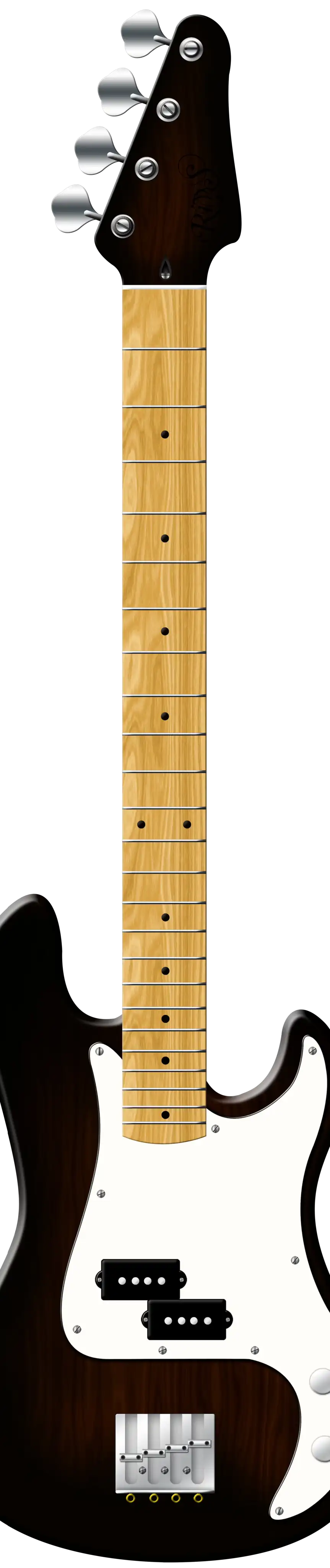
Tap a note to hear it. Scroll along the neck to explore frets.
Keyboard controls
Keyboard: use arrow keys to move between notes, then Enter or Space to play.
About this fretboard
Learn a four-string bass in standard E–A–D–G tuning. Its open strings sound an octave below the lowest four guitar strings. Locate roots across the neck and hear how the same note name can occupy different registers.
How the fretboard repeats
Fret 12 has the same note name as the open string, one octave higher. The pattern repeats every 12 frets. Between E and F, and between B and C, there is one semitone; the other adjacent natural notes are two semitones apart.
Every neighboring pair of strings is a perfect fourth apart. Fret 5 on one string matches the next open string above it. This consistent tuning lets you move patterns across the neck without the guitar’s G-to-B adjustment.
Try this
- Highlight A.
- Compare fret 5 on the E string with the open A string: they have the same pitch.
- Then find A at fret 7 on the D string, one octave higher. Practice naming roots before playing a bass line.
Put the notes into practice
Today’s Fretuodle uses the shared theme, which may differ from this reference. Your practice here does not affect Fretuodle results.
Take it beyond the daily challenge
Explore notes and scales at your own pace in the learning library, or keep practicing on your mobile device with Fretuoso®.
 Discover Fretuoso®